
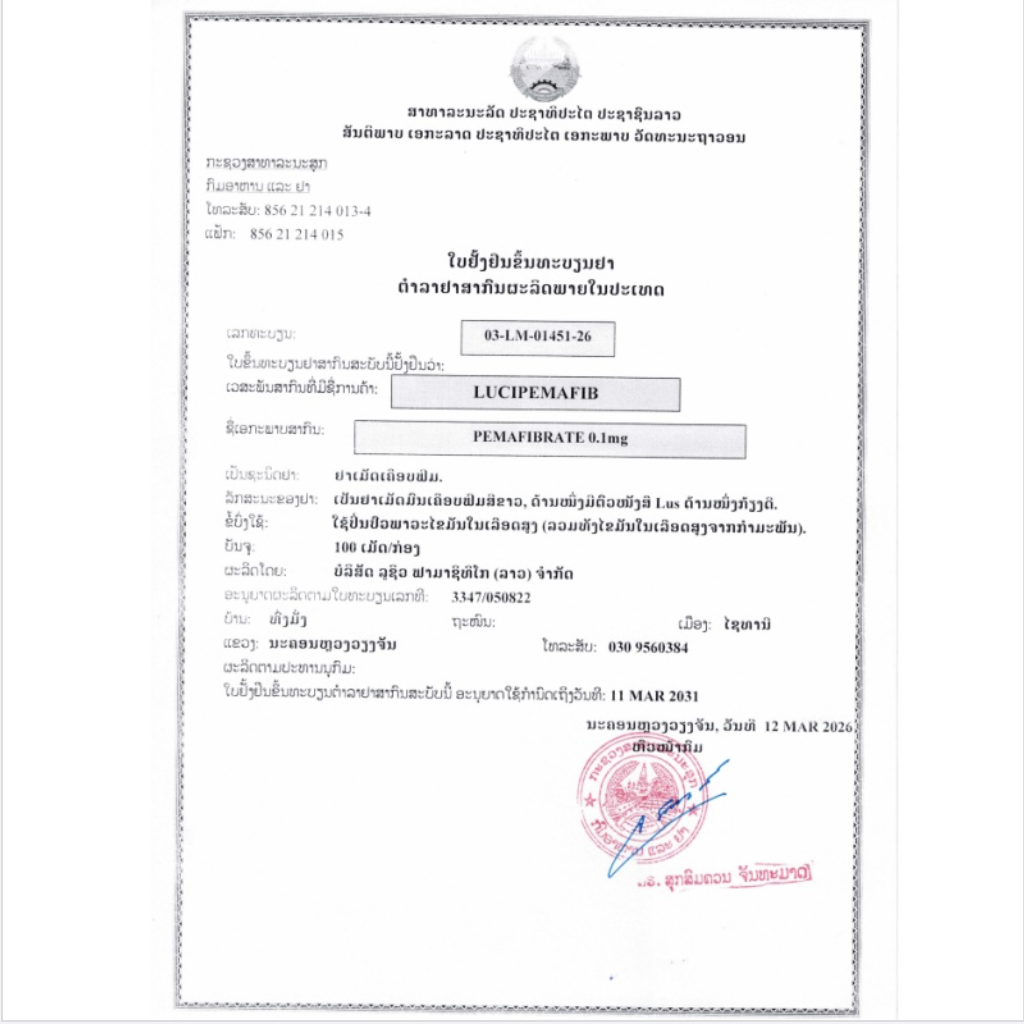

HIGHLIGHTS OF PRESCRIBING INFORMATION
These highlights do not include all the information needed to use LuciPemafib safely and effectively. See full prescribing information for LuciPemafib.
INDICATIONS AND USAGE
Hyperlipidemia (including familial hyperlipidemia).
DOSAGE AND ADMINISTRATION
The usual adult dosage is 0.1 mg of pemafibrate administered orally twice daily, in the morning and evening. The dosage may be increased or decreased depending on age and symptoms, with a maximum dose of 0.2 mg administered twice daily.
DOSAGE FORMS AND STRENGTHS
Tablets: 0.1 mg×100 tablets
CONTRAINDICATIONS
• Patients with a history of hypersensitivity to any of the drug's components.
• Patients with severe liver impairment, Child-Pugh class B or C liver cirrhosis, or biliary obstruction.
• Patients with gallstones.
• Pregnant women or women who may be pregnant.
• Patients receiving cyclosporine or rifampicin.
WARNINGS AND PRECAUTIONS
• Prior to administration, dietary therapy, the basis of hyperlipidemia treatment, should be implemented. Furthermore, exercise therapy and reduction of risk factors for ischemic heart disease, such as hypertension and smoking, should also be fully considered.
• Serum lipid levels should be monitored regularly during administration. If no effect of this drug is observed, discontinue administration without any consideration.
• Because this drug may affect liver function and liver function test values, liver function tests should be performed regularly during administration.
• LDL-cholesterol levels may increase during administration of this drug. Regularly monitor LDL-cholesterol levels during administration.
ADVERSE REACTIONS
Serious Adverse Reactions
Rhabdomyolysis (Incidence Unknown)
Rhabdomyolysis, characterized by muscle pain, weakness, elevated CK, and elevated blood and urinary myoglobin levels, may occur. This may be accompanied by severe renal impairment, such as acute kidney injury. In such cases, immediately discontinue administration and take appropriate measures.
USE IN SPECIFIC POPULATIONS
• Patients with Renal Impairment
Patients with renal impairment and eGFR <30 mL/min/1.73 m2
Rhabdomyolysis may occur.
Patients with Abnormal Renal Function Laboratory Tests.
When using this drug in combination with an HMG-CoA reductase inhibitor, use should be limited to cases where it is deemed necessary for treatment. Rhabdomyolysis accompanied by a rapid deterioration in renal function is likely to occur. If coadministration is unavoidable, start with a low dose of rivaroxaban and periodically conduct renal function tests. If symptoms (muscle pain, weakness), elevated CK, elevated blood and urinary myoglobin, or elevated serum creatinine are observed, discontinue administration immediately.
• Patients with Hepatic Impairment
Patients with severe hepatic impairment, Child-Pugh class B or C cirrhosis, or biliary obstruction.
Do not administer. This drug may worsen liver impairment. It may also increase plasma concentrations of rivaroxaban.
Patients with hepatic impairment (e.g., patients with Child-Pugh class A cirrhosis) or a history of hepatic impairment (excluding patients falling under 9.3.1)
Consider dose reduction of rivaroxaban, if necessary. Carefully consider the need to increase the dose of this drug. Abnormal changes in liver function tests may occur. Plasma concentrations of this drug may be elevated in patients with liver impairment (e.g., patients with Child-Pugh class A cirrhosis).
• Pregnant Women
Do not administer to pregnant women or women who may be pregnant.
• Nursing Women
Nursing is not recommended. Transfer to breast milk has been reported in animal studies (rat).
• Children, etc.
No clinical trials evaluating efficacy and safety in children, etc. have been conducted.
• Elderly
Administer with caution, paying close attention to the occurrence of adverse reactions and closely monitoring the patient's progress. Generally, patients have impaired physiological function.
Storage
Store at 20°C to 25°C (68°F to 77°F), excursions permitted between 15°C and 30°C (59°F and 86°F) [see USP Controlled Room Temperature]. Protect from moisture.