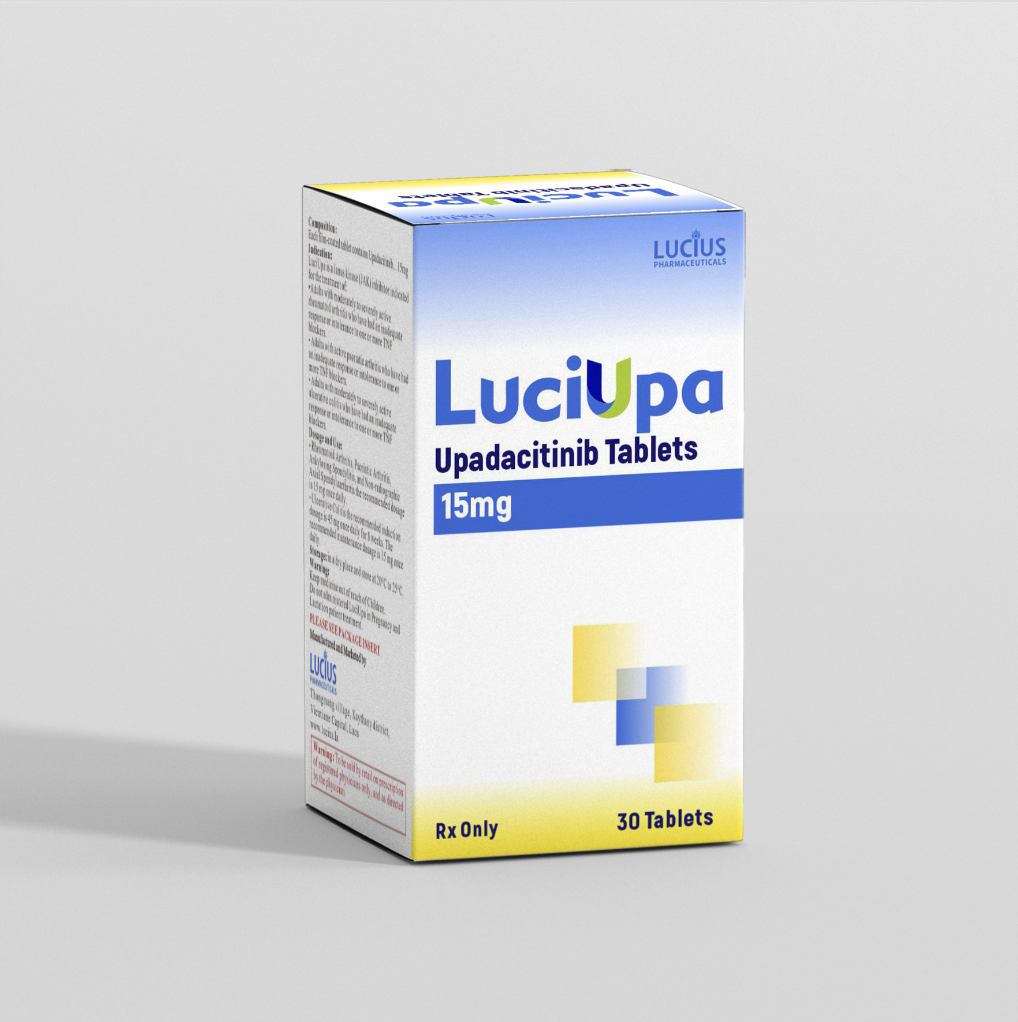
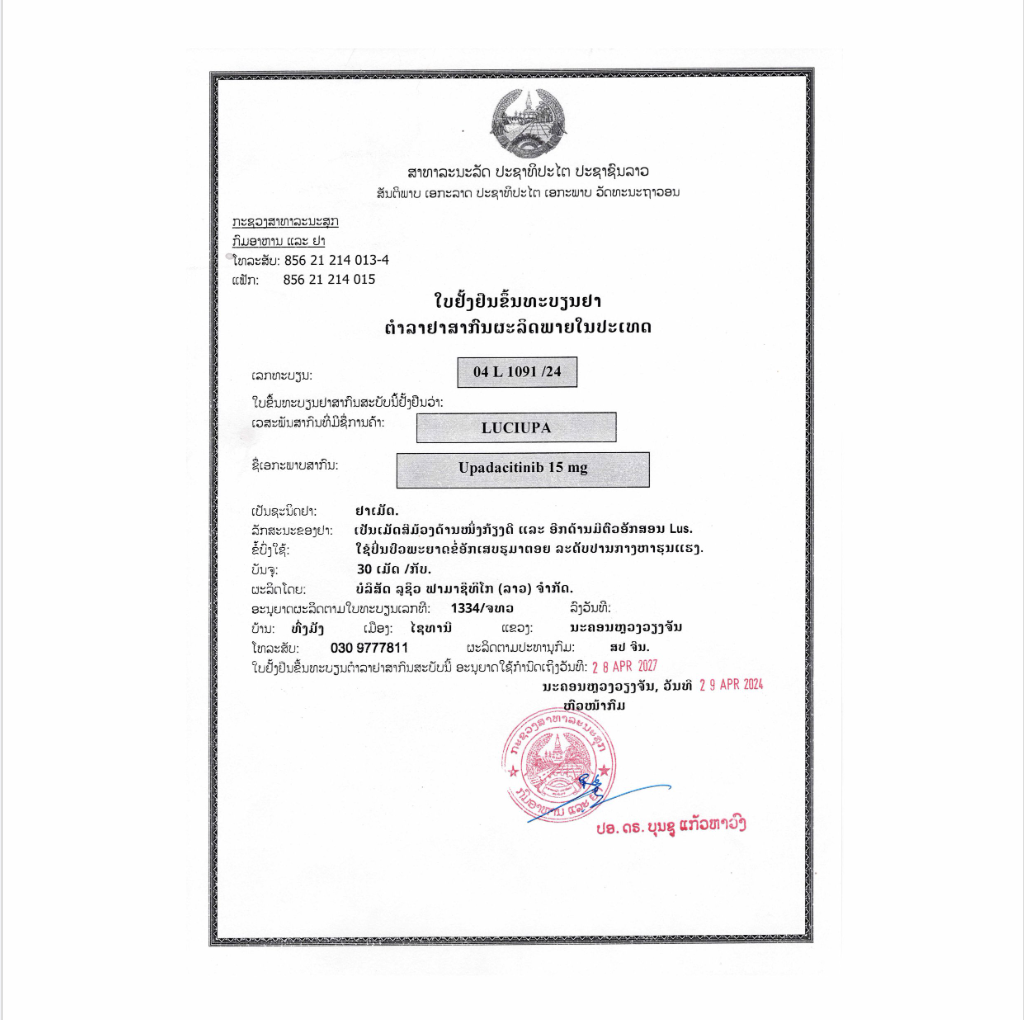

HIGHLIGHTS OF PRESCRIBING INFORMATION
These highlights do not include all the information needed to use LuciUpa safely and effectively. See full prescribing information for LuciUpa.
INDICATIONS AND USAGE
LuciUpa is a Janus kinase (JAK) inhibitor indicated for the treatment of:
· Adults with moderately to severely active rheumatoid arthritis who have had an inadequate response or intolerance to one or more TNF blockers.
Limitations of Use LuciUpa is not recommended for use in combination with other JAK inhibitors, biologic DMARDs, or with potent immunosuppressants such as azathioprine and cyclosporine.
· Adults with active psoriatic arthritis who have had an inadequate response or intolerance to one or more TNF blockers.
Limitations of Use LuciUpa is not recommended for use in combination with other JAK inhibitors, biologic DMARDs, or with potent immunosuppressants such as azathioprine and cyclosporine.
· Adults and pediatric patients 12 years of age and older with refractory, moderate to severe atopic dermatitis whose disease is not adequately controlled with other systemic drug products, including biologics, or when use of those therapies are inadvisable.
Limitations of Use LuciUpa is not recommended for use in combination with other JAK inhibitors, biologic immunomodulators, or with other immunosuppressants.
· Adults with moderately to severely active ulcerative colitis who have had an inadequate response or intolerance to one or more TNF blockers.
Limitations of Use LuciUpa is not recommended for use in combination with other JAK inhibitors, biological therapies for ulcerative colitis, or with potent immunosuppressants such as azathioprine and cyclosporine.
· Adults with moderately to severely active Crohn’s disease who have had an inadequate response or intolerance to one or more TNF blockers.
Limitations of Use LuciUpa is not recommended for use in combination with other JAK inhibitors, biological therapies for Crohn’s disease, or with potent immunosuppressants such as azathioprine and cyclosporine.
· Adults with active ankylosing spondylitis who have had an inadequate response or intolerance to one or more TNF blockers.
Limitations of Use LuciUpa is not recommended for use in combination with other JAK inhibitors, biologic DMARDs, or with potent immunosuppressants such as azathioprine and cyclosporine.
· Adults with active non-radiographic axial spondyloarthritis with objective signs of inflammation who have had an inadequate response or intolerance to TNF blocker therapy.
Limitations of Use LuciUpa is not recommended for use in combination with other JAK inhibitors, biologic DMARDs, or with potent immunosuppressants such as azathioprine and cyclosporine.
DOSAGE AND ADMINISTRATION
· Prior to treatment update immunizations and consider evaluating for active and latent tuberculosis, viral hepatitis, hepatic function, and pregnancy status
· Avoid initiation or interrupt LuciUpa if absolute lymphocyte count is less than 500 cells/mm3 , absolute neutrophil count is less than 1000 cells/mm3 , or hemoglobin level is less than 8 g/dL.
Rheumatoid Arthritis, Psoriatic Arthritis, Ankylosing Spondylitis, and Nonradiographic Axial Spondyloarthritis
· The recommended dosage is 15 mg once daily.
Atopic Dermatitis
· Pediatric Patients 12 Years of Age and Older Weighing at Least 40 kg and Adults Less Than 65 Years of Age: Initiate treatment with 15 mg orally once daily. If an adequate response is not achieved, consider increasing the dosage to 30 mg orally once daily.
· Adults 65 Years of Age and Older: Recommended dosage is 15 mg once daily.
· Severe Renal Impairment: Recommended dosage is 15 mg once daily.
Ulcerative Colitis
· Adults: The recommended induction dosage is 45 mg once daily for 8 weeks. The recommended maintenance dosage is 15 mg once daily. A maintenance dosage of 30 mg once daily may be considered for patients with refractory, severe, or extensive disease. Discontinue LuciUpa if adequate therapeutic response is not achieved with the 30 mg dosage. Use the lowest effective dosage needed to maintain response.
· See the Full Prescribing Information for the recommended dosage in patients with renal or hepatic impairment and for dosage modification due to drug interactions.
Crohn’s Disease
· Adults: The recommended induction dosage is 45 mg once daily for 12 weeks. The recommended maintenance dosage is 15 mg once daily. A maintenance dosage of 30 mg once daily may be considered for patients with refractory, severe, or extensive disease. Discontinue LuciUpa if an adequate therapeutic response is not achieved with the 30 mg dosage. Use the lowest effective dosage needed to maintain response.
· See the Full Prescribing Information for the recommended dosage in patients with renal or hepatic impairment and for dosage modification due to drug interactions.
DOSAGE FORMS AND STRENGTHS
Tablets: 15 mg×30 tablets
CONTRAINDICATIONS
Known hypersensitivity to upadacitinib or any of the excipients in LuciUpa.
WARNINGS AND PRECAUTIONS
• Serious Infections: Avoid use in patients with active, serious infection, including localized infections.
• Hypersensitivity: Serious hypersensitivity reactions (e.g., anaphylaxis) have been reported. Discontinue if a serious hypersensitivity reaction occurs.
• Gastrointestinal (GI) Perforations: Monitor patients at risk for GI perforations and promptly evaluate patients with symptoms.
• Laboratory Abnormalities: Monitoring recommended due to potential changes in lymphocytes, neutrophils, hemoglobin, liver enzymes and lipids.
• Embryo-Fetal Toxicity: May cause fetal harm based on animal studies. Advise female patients of reproductive potential of the potential risk to a fetus and to use effective contraception.
• Vaccinations: Avoid use with live vaccines.
• Medication Residue in Stool: Observed in stool or ostomy output in patients with shortened GI transit times. Monitor patients clinically and consider alternative treatment if inadequate therapeutic response.
ADVERSE REACTIONS
• Rheumatoid arthritis, psoriatic arthritis, ankylosing spondylitis, and nonradiographic axial spondyloarthritis: Adverse reactions (≥ 1%) were: upper respiratory tract infections, herpes zoster, herpes simplex, bronchitis, nausea, cough, pyrexia, acne, and headache.
• Atopic dermatitis: Adverse reactions (≥ 1%) are: upper respiratory tract infections, acne, herpes simplex, headache, blood creatine phosphokinase increased, cough, hypersensitivity, folliculitis, nausea, abdominal pain, pyrexia, increased weight, herpes zoster, influenza, fatigue, neutropenia, myalgia, and influenza like illness.
• Ulcerative colitis: Adverse reactions (≥ 5%) reported during induction or maintenance are: upper respiratory tract infections, increased blood creatine phosphokinase, acne, neutropenia, elevated liver enzymes, and rash.
• Crohn’s disease: Adverse reactions (≥ 5%) reported during induction or maintenance are: upper respiratory tract infections, anemia, pyrexia, acne, herpes zoster, and headache.
DRUG INTERACTIONS
• Strong CYP3A4 Inhibitors: See the Full Prescribing Information for dosage modification for patients with atopic dermatitis, ulcerative colitis, and Crohn’s disease.
• Strong CYP3A4 Inducers: Coadministration of LuciUpa with strong CYP3A4 inducers is not recommended.
USE IN SPECIFIC POPULATIONS
• Lactation: Advise not to breastfeed.
• Hepatic Impairment: LuciUpa is not recommended in patients with severe hepatic impairment.
Storage
Store at 20℃ to 25℃ (68℉ to 77℉), excursions permitted between 15℃ and 30℃ (59℉ and 86℉) [see USP Controlled Room Temperature]. Protect from moisture.