

HIGHLIGHTS OF PRESCRIBING INFORMATION
These highlights do not include all the information needed to use LuciRepo safely and effectively. See full prescribing information for LuciRepo.
INDICATIONS AND USAGE
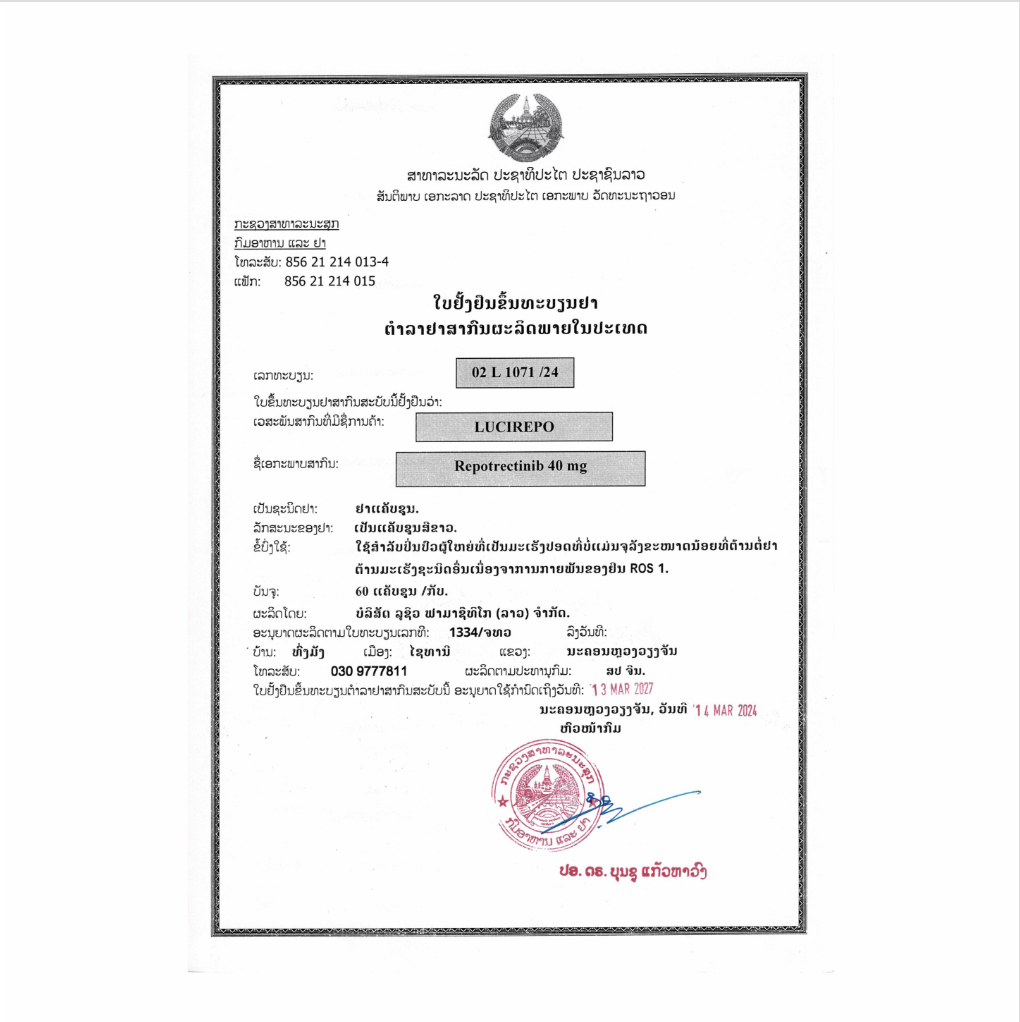
LuciRepo is a kinase inhibitor indicated for the treatment of adult patients with locally
advanced or metastatic ROS1-positive non-small cell lung cancer (NSCLC).
DOSAGE AND ADMINISTRATION
• Select patients for the treatment of locally advanced or metastatic NSCLC based on the presence of ROS1 rearrangement(s) in tumor specimens.
• Recommended Dosage: 160 mg orally once daily for 14 days, then increase to 160 mg twice daily, with or without food.
DOSAGE FORMS AND STRENGTHS
Capsules: 40 mg×60 capsules
CONTRAINDICATIONS
None.
WARNINGS AND PRECAUTIONS
• Central Nervous System (CNS) Effects: Can cause CNS adverse reactions including dizziness, ataxia, and cognitive impairment. Withhold and then resume at same or reduced dose upon improvement, or permanently discontinue LuciRepo based on severity.
• Interstitial Lung Disease (ILD)/Pneumonitis: Monitor patients for new or worsening pulmonary symptoms indicative of ILD/pneumonitis. Immediately withhold in patients with suspected ILD/pneumonitis and permanently discontinue if ILD/pneumonitis is confirmed.
• Hepatotoxicity: Monitor liver function tests every 2 weeks during the first month of treatment, and as clinically indicated thereafter. Based on severity, withhold and then resume at same or reduced dose, or permanently discontinue.
• Myalgia with Creatine Phosphokinase (CPK) Elevation: Monitor serum CPK levels during treatment in patients reporting unexplained muscle pain, tenderness, or weakness. Based on severity, withhold and resume at same or reduced dose upon improvement.
• Hyperuricemia: Monitor serum uric acid levels prior to initiating and periodically during treatment. Initiate treatment with urate-lowering medications as clinically indicated. Withhold and resume at same or reduced dose, or permanently discontinue based on severity.
• Skeletal Fractures: Promptly evaluate patients with signs or symptoms (e.g., pain, changes in mobility, deformity) of fractures.
• Embryo-Fetal Toxicity: Can cause fetal harm. Advise females of reproductive potential of the potential risk to a fetus and to use an effective non-hormonal method of contraception.
ADVERSE REACTIONS
The most common adverse reactions (≥20%) were dizziness, dysgeusia, peripheral neuropathy, constipation, dyspnea, ataxia, fatigue, cognitive disorders, and muscular weakness.
DRUG INTERACTIONS
• Strong and Moderate CYP3A Inhibitors: Avoid concomitant use.
• P-gp inhibitors: Avoid concomitant use.
• Strong and Moderate CYP3A Inducers: Avoid concomitant use.
• Certain CYP3A Substrates: Avoid concomitant use with CYP3A substrates, where minimal concentration changes can cause reduced efficacy.
• Hormonal contraceptives: Avoid concomitant use.
USE IN SPECIFIC POPULATIONS
• Lactation: Advise not to breastfeed.
Storage
Store at 20℃ to 25℃ (68℉ to 77℉), excursions permitted between 15℃ and 30℃ (59℉ and 86℉) [see USP Controlled Room Temperature]. Protect from moisture.