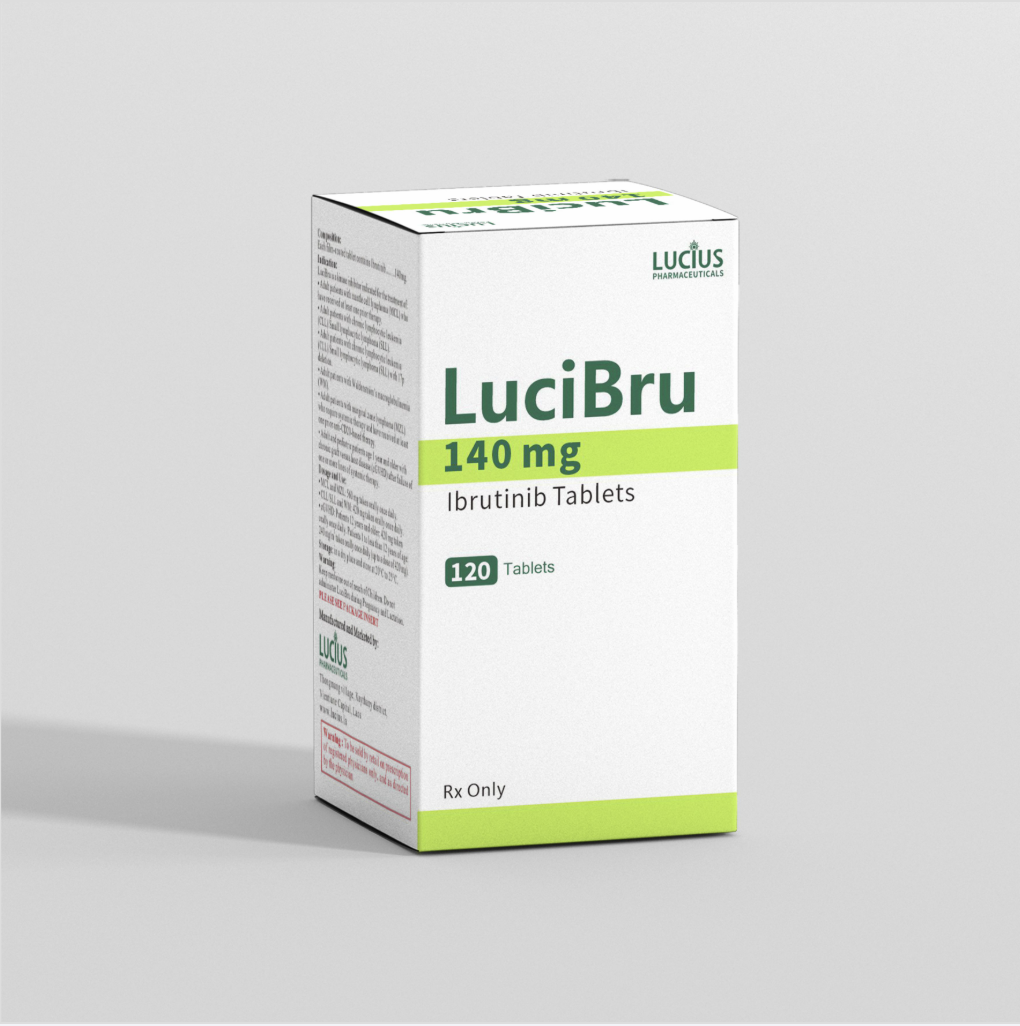
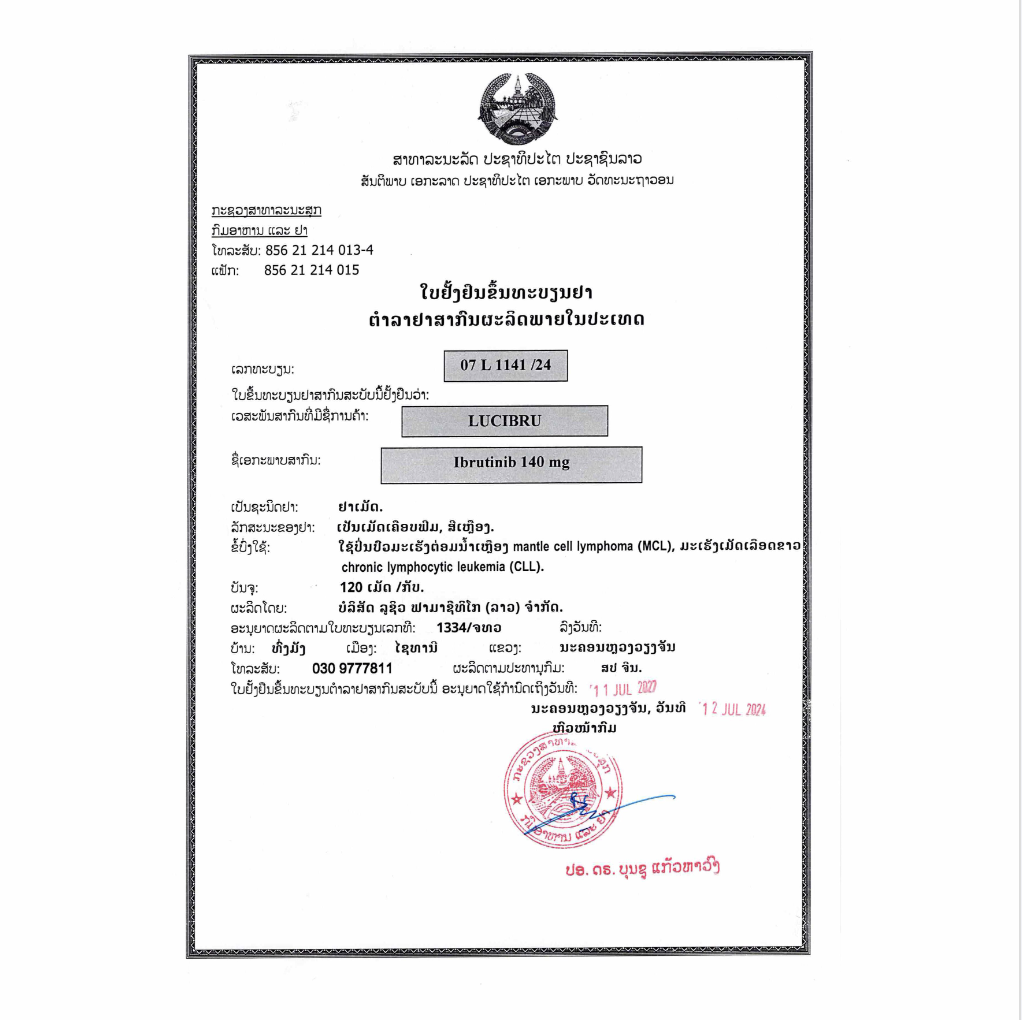

HIGHLIGHTS OF PRESCRIBING INFORMATION
These highlights do not include all the information needed to use LuciBru safely and effectively. See full prescribing information for LuciBru.
INDICATIONS AND USAGE
LuciBru is a kinase inhibitor indicated for the treatment of:
• Adult patients with mantle cell lymphoma (MCL) who have received at least one prior therapy .
This indication is approved under accelerated approval based on overall response rate. Continued approval for this indication may be contingent upon verification and description of clinical benefit in a confirmatory trial(s).
• Adult patients with chronic lymphocytic leukemia (CLL)/Small lymphocytic lymphoma (SLL) .
• Adult patients with chronic lymphocytic leukemia (CLL)/Small lymphocytic lymphoma (SLL) with 17p deletion.
• Adult patients with Waldenström’s macroglobulinemia (WM) .
• Adult patients with marginal zone lymphoma (MZL) who require systemic therapy and have received at least one prior anti-CD20-based therapy .
This indication is approved under accelerated approval based on overall response rate. Continued approval for this indication may be contingent upon verification and description of clinical benefit in a confirmatory trial(s).
• Adult and pediatric patients age 1 year and older with chronic graft versus host disease (cGVHD) after failure of one or more lines of systemic therapy .
DOSAGE AND ADMINISTRATION
• MCL and MZL: 560 mg taken orally once daily.
• CLL/SLL and WM: 420 mg taken orally once daily.
• cGVHD:
o Patients 12 years and older: 420 mg taken orally once daily.
o Patients 1 to less than 12 years of age: 240 mg/m2 taken orally once daily (up to a dose of 420 mg).
Tablets should be taken orally with a glass of water. Do not cut, crush, or chew the tablets.
DOSAGE FORMS AND STRENGTHS
Tablets: 140 mg×120 tablets
CONTRAINDICATIONS
None. (4)
WARNINGS AND PRECAUTIONS
• Hemorrhage: Monitor for bleeding and manage.
• Infections: Monitor patients for fever and infections, evaluate promptly, and treat.
• Cardiac Arrhythmias, Cardiac Failure, and Sudden Death: Monitor for symptoms of arrhythmias and cardiac failure and manage.
• Hypertension: Monitor blood pressure and treat.
• Cytopenias: Check complete blood counts monthly.
• Second Primary Malignancies: Other malignancies have occurred in patients, including skin cancers, and other carcinomas.
• Tumor Lysis Syndrome (TLS): Assess baseline risk and take precautions. Monitor and treat for TLS.
• Embryo-Fetal Toxicity: Can cause fetal harm. Advise females of reproductive potential of the potential risk to a fetus and to use effective contraception.
ADVERSE REACTIONS
• The most common (≥30%) adverse reactions in patients with B-cell malignancies (MCL, CLL/SLL, WM and MZL) are thrombocytopenia, diarrhea, fatigue, musculoskeletal pain, neutropenia, rash, anemia, and bruising.
• The most common (≥20%) adverse reactions in adult or pediatric patients with cGVHD are fatigue, anemia, bruising, diarrhea, thrombocytopenia, musculoskeletal pain, pyrexia, muscle spasms, stomatitis, hemorrhage, nausea, abdominal pain, pneumonia, and headache.
DRUG INTERACTIONS
• CYP3A Inhibitors: Modify LuciBru dose as described.
• CYP3A Inducers: Avoid coadministration with strong CYP3A inducers.
USE IN SPECIFIC POPULATIONS
• Lactation: Advise not to breastfeed.
• Hepatic Impairment: Avoid use of LuciBru in patients with severe hepatic impairment. In patients with mild or moderate impairment, reduce LuciBru dose.
Storage
Store at 20°C to 25°C (68°F to 77°F), excursions permitted between 15°C and 30°C (59°F and 86°F) [see USP Controlled Room Temperature]. Protect from moisture.