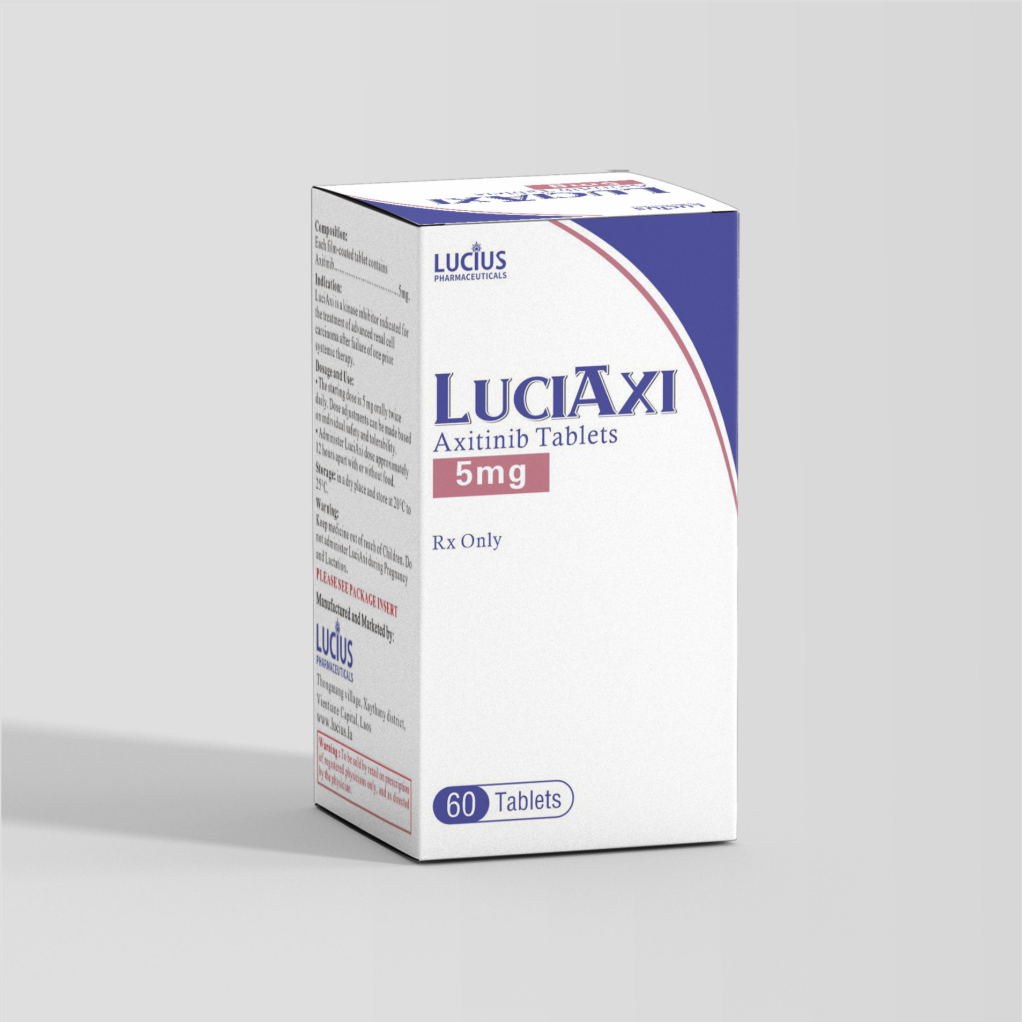
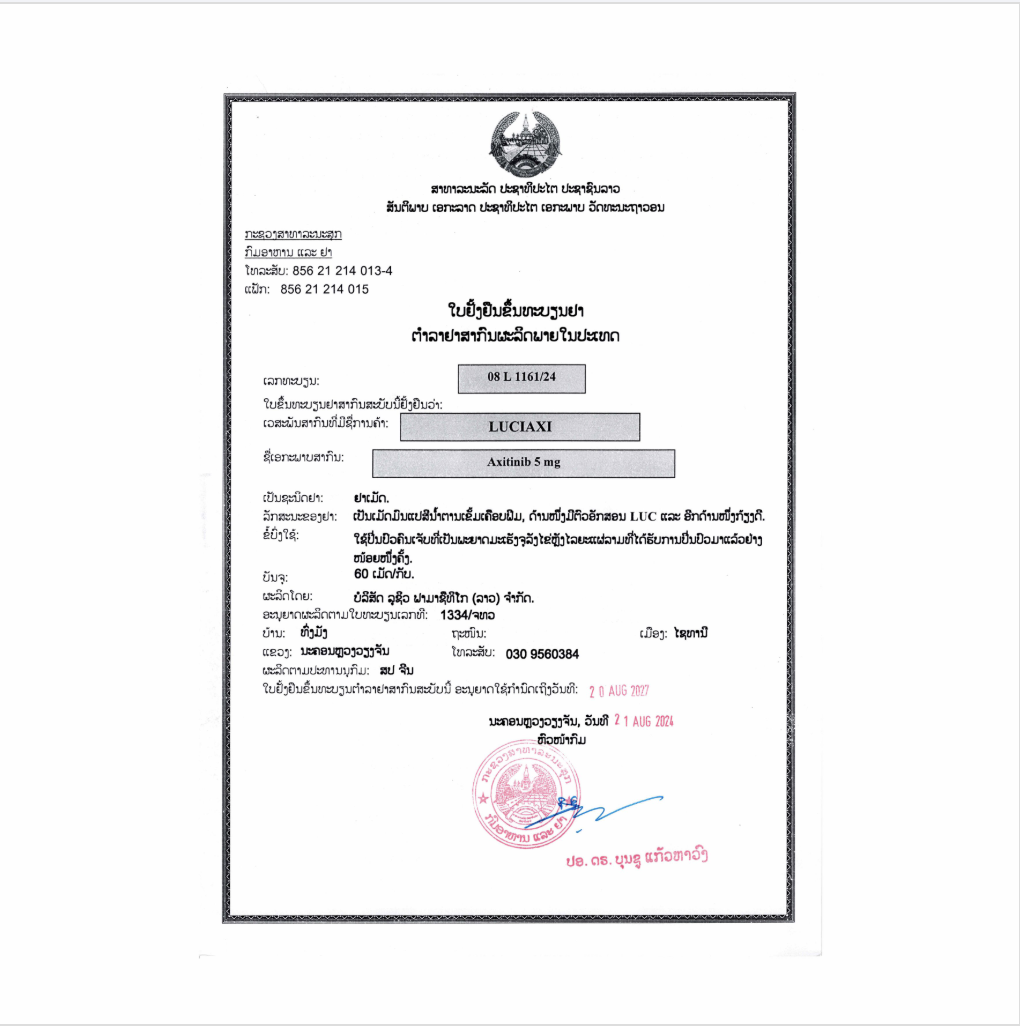

HIGHLIGHTS OF PRESCRIBING INFORMATION
These highlights do not include all the information needed to use LuciAxi safely and effectively. See full prescribing information for LuciAxi.
INDICATIONS AND USAGE
LuciAxi is a kinase inhibitor indicated for the treatment of advanced renal cell carcinoma after failure of one prior systemic therapy.
DOSAGE AND ADMINISTRATION
• The starting dose is 5 mg orally twice daily. Dose adjustments can be made based on individual safety and tolerability.
• Administer LuciAxi dose approximately 12 hours apart with or without food.
• LuciAxi should be swallowed whole with a glass of water.
• If a strong CYP3A4/5 inhibitor is required, decrease the LuciAxi dose by approximately half.
• For patients with moderate hepatic impairment, decrease the starting dose by approximately half.
DOSAGE FORMS AND STRENGTHS
Tablets: 5 mg×60 tablets
CONTRAINDICATIONS
None.
WARNINGS AND PRECAUTIONS
• Hypertension including hypertensive crisis has been observed. Blood pressure should be well-controlled prior to initiating LuciAxi. Monitor for hypertension and treat as needed. For
persistent hypertension despite use of anti-hypertensive medications, reduce the LuciAxi dose.
• Arterial and venous thrombotic events have been observed and can be fatal. Use with caution in patients who are at increased risk for these events.
• Hemorrhagic events, including fatal events, have been reported. LuciAxi has not been studied in patients with evidence of untreated brain metastasis or recent active gastrointestinal bleeding and should not be used in those patients.
• Gastrointestinal perforation and fistula, including death, have occurred. Use with caution in patients at risk for gastrointestinal perforation or fistula.
• Hypothyroidism requiring thyroid hormone replacement has been reported. Monitor thyroid function before initiation of, and periodically throughout, treatment with LuciAxi.
• Stop LuciAxi at least 24 hours prior to scheduled surgery.
• Reversible Posterior Leukoencephalopathy Syndrome (RPLS) has been observed. Permanently discontinue LuciAxi if signs or symptoms of RPLS occur.
• Monitor for proteinuria before initiation of, and periodically throughout, treatment with LuciAxi. For moderate to severe proteinuria, reduce the dose or temporarily interrupt treatment with LuciAxi.
• Liver enzyme elevation has been observed during treatment with LuciAxi. Monitor ALT, AST and bilirubin before initiation of, and periodically throughout, treatment with LuciAxi.
• The starting dose of LuciAxi should be decreased if used in patients with moderate hepatic impairment. LuciAxi has not been studied in patients with severe hepatic impairment.
• LuciAxi can cause fetal harm when administered to a pregnant woman based on its mechanism of action. Women of childbearing potential should be advised of the potential hazard to the fetus and to avoid becoming pregnant while receiving LuciAxi.
ADVERSE REACTIONS
The most common (≥20%) adverse reactions are diarrhea, hypertension, fatigue, decreased appetite, nausea, dysphonia, palmar-plantar erythrodysesthesia (hand-foot) syndrome, weight decreased, vomiting, asthenia, and constipation.
DRUG INTERACTIONS
• Avoid strong CYP3A4/5 inhibitors. If unavoidable, reduce the LuciAxi dose.
• Avoid strong CYP3A4/5 inducers.
Storage
Store at 20℃ to 25℃ (68℉ to 77℉), excursions permitted between 15℃ and 30℃ (59℉ and 86℉) [see USP Controlled Room Temperature]. Protect from moisture.