
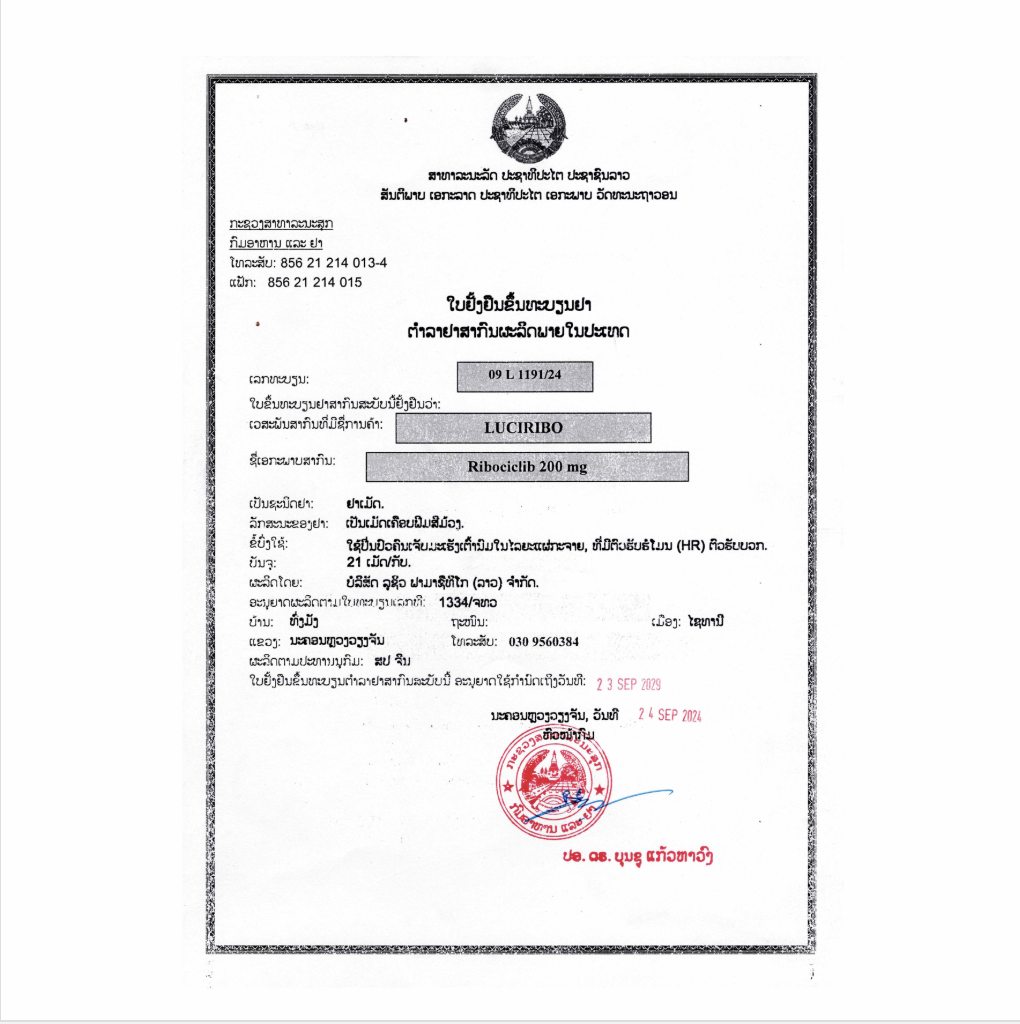

HIGHLIGHTS OF PRESCRIBING INFORMATION
These highlights do not include all the information needed to use LuciRibo safely and effectively. See full prescribing information for LuciRibo.
INDICATIONS AND USAGE
LuciRibo is a kinase inhibitor indicated for the treatment of adult patients with hormone receptor (HR)-positive, human epidermal growth factor receptor 2 (HER2)-negative advanced or metastatic breast cancer in combination with:
• an aromatase inhibitor as initial endocrine-based therapy; or
• fulvestrant as initial endocrine-based therapy or following disease progression on endocrine therapy in postmenopausal women or in men.
DOSAGE AND ADMINISTRATION
LuciRibo tablets are taken orally with or without food in combination with an aromatase inhibitor or fulvestrant.
• Recommended starting dose: 600 mg orally (three 200 mg tablets) taken once daily with or without food for 21 consecutive days followed by 7 days off treatment.
• Dose interruption, reduction, and/or discontinuation may be required based on individual safety and tolerability.
DOSAGE FORMS AND STRENGTHS
Tablets: 200 mg×21 tablets
CONTRAINDICATIONS
None.
WARNINGS AND PRECAUTIONS
• Interstitial Lung Disease (ILD)/Pneumonitis: Patients treated with CDK 4/6 inhibitors should be monitored for pulmonary symptoms indicative of ILD/pneumonitis. Interrupt and evaluate patients with new or worsening respiratory symptoms suspected to be due to ILD/pneumonitis. Permanently discontinue LuciRibo in patients with recurrent symptomatic or severe ILD/pneumonitis.
• Severe Cutaneous Adverse Reactions (SCARs): Stevens-Johnson syndrome (SJS), Toxic epidermal necrolysis (TEN), and drug-reaction with eosinophilia and systemic symptoms (DRESS) can occur with LuciRibo treatment. Permanently discontinue LuciRibo in patients with SCARs or other life-threatening cutaneous reactions.
• QT Interval Prolongation: Monitor electrocardiograms (ECGs) and electrolytes prior to initiation of treatment with LuciRibo. Repeat ECGs at approximately Day 14 of the first cycle and at the beginning of the second cycle, and as clinically indicated. Monitor electrolytes at the beginning of each cycle for 6 cycles, and as clinically indicated. Avoid using LuciRibo with drugs known to prolong QT interval and/or strong CYP3A inhibitors.
• Increased QT Prolongation with Concomitant Use of Tamoxifen: LuciRibo is not indicated for concomitant use with tamoxifen.
• Hepatobiliary Toxicity: Increases in serum transaminase levels have been observed. Perform liver function tests (LFTs) before initiating treatment with LuciRibo. Monitor LFTs every 2 weeks for the first 2 cycles, at the beginning of each subsequent 4 cycles, and as clinically indicated.
• Neutropenia: Perform complete blood count (CBC) before initiating therapy with LuciRibo. Monitor CBC every 2 weeks for the first 2 cycles, at the beginning of each subsequent 4 cycles, and as clinically indicated.
• Embryo-Fetal Toxicity: Can cause fetal harm. Advise females of reproductive potential of potential risk to a fetus and to use effective contraception during therapy.
ADVERSE REACTIONS
Most common (incidence ≥ 20%) adverse reactions, including laboratory abnormalities, are leukocytes decreased, neutrophils decreased, hemoglobin decreased, lymphocytes decreased, aspartate aminotransferase increased, gamma glutamyl transferase increased, alanine aminotransferase increased, infections, nausea, creatinine increased, fatigue, platelets decreased, diarrhea, vomiting, headache, constipation, alopecia, cough, rash, back pain, and glucose serum decreased.
DRUG INTERACTIONS
• CYP3A4 Inhibitors: Avoid concomitant use of LuciRibo with strong CYP3A inhibitors. If strong inhibitors cannot be avoided, reduce LuciRibo dose.
• CYP3A4 Inducers: Avoid concomitant use of LuciRibo with strong CYP3A inducers.
• CYP3A Substrates: The dose of sensitive CYP3A substrates with narrow therapeutic indices may need to be reduced when given concurrently with LuciRibo.
• Drugs Known to Prolong QT Interval: Avoid concomitant use of drugs known to prolong QT interval, such as anti-arrhythmic medicines.
USE IN SPECIFIC POPULATIONS
Lactation: Advise not to breastfeed.
Storage
Store at 20℃ to 25℃ (68℉ to 77℉), excursions permitted between 15℃ and 30℃ (59℉ and 86℉) [see USP Controlled Room Temperature]. Protect from moisture.