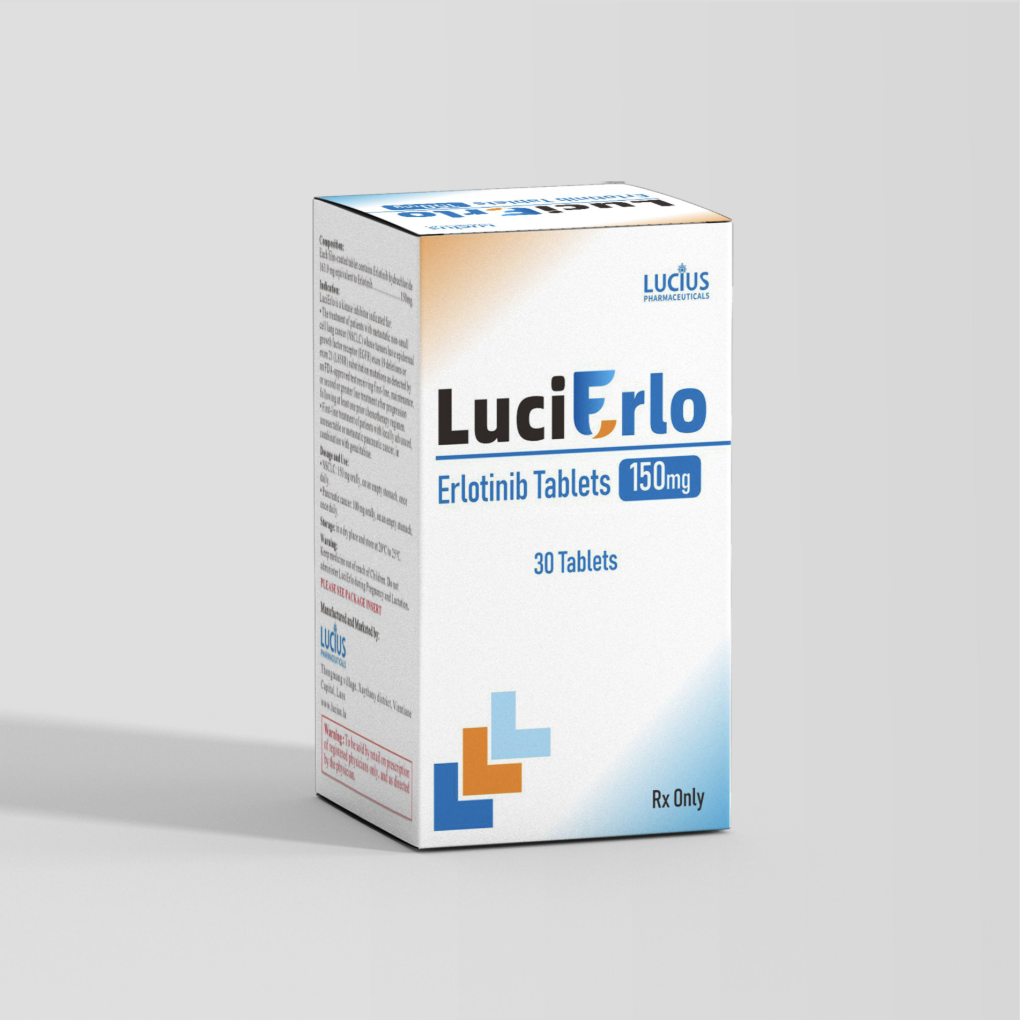
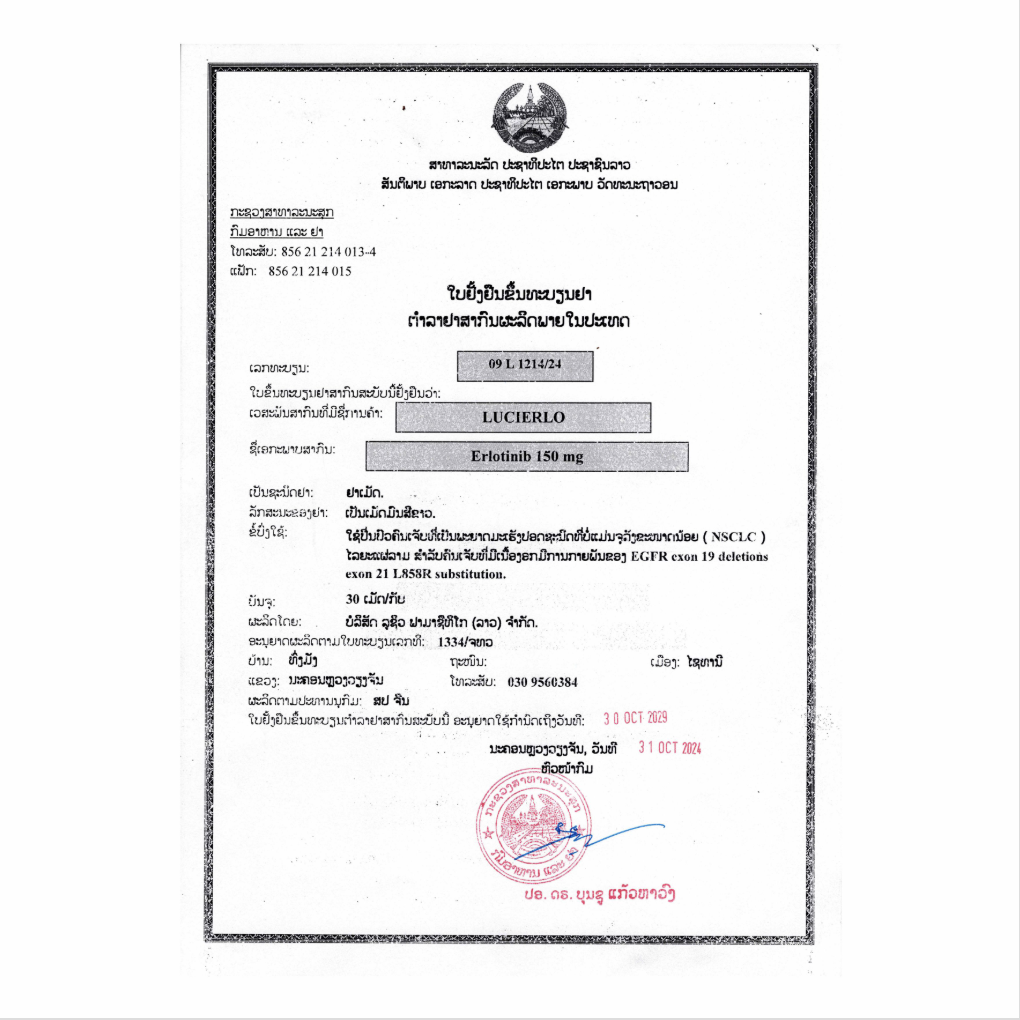

HIGHLIGHTS OF PRESCRIBING INFORMATION
These highlights do not include all the information needed to use LuciErlo safely and effectively. See full prescribing information for LuciErlo.
INDICATIONS AND USAGE
LuciErlo is a kinase inhibitor indicated for:
· The treatment of patients with metastatic non-small cell lung cancer (NSCLC) whose tumors have epidermal growth factor receptor (EGFR) exon 19 deletions or exon 21 (L858R) substitution mutations as detected by an FDA-approved test receiving first-line, maintenance, or second or greater line treatment after progression following at least one prior chemotherapy regimen.
· First-line treatment of patients with locally advanced, unresectable or metastatic pancreatic cancer, in combination with gemcitabine.
Limitations of Use:
· Safety and efficacy of LuciErlo have not been established in patients with NSCLC whose tumors have other EGFR mutations.
· LuciErlo is not recommended for use in combination with platinumbased chemotherapy.
DOSAGE AND ADMINISTRATION
· NSCLC: 150 mg orally, on an empty stomach, once daily.
· Pancreatic cancer: 100 mg orally, on an empty stomach, once daily.
DOSAGE FORMS AND STRENGTHS
Tablets: 150 mg×30 tablets
CONTRAINDICATIONS
None.
WARNINGS AND PRECAUTIONS
· Interstitial lung disease (ILD): Occurs in 1.1% of patients. Withhold LuciErlo for acute onset of new or progressive unexplained pulmonary symptoms, such as dyspnea, cough and fever. Discontinue LuciErlo if ILD is diagnosed.
· Renal failure: Monitor renal function and electrolytes, particularly in patients at risk of dehydration. Withhold LuciErlo for severe renal toxicity.
· Hepatotoxicity: Occurs with or without hepatic impairment, including hepatic failure and hepatorenal syndrome: Monitor periodic liver testing. Withhold or discontinue LuciErlo for severe or worsening liver tests.
· Gastrointestinal perforations: Discontinue LuciErlo.
· Bullous and exfoliative skin disorders: Discontinue LuciErlo.
· Cerebrovascular accident (CVA): The risk of CVA is increased in patients with pancreatic cancer.
· Microangiopathic hemolytic anemia (MAHA): The risk of MAHA is increased in patients with pancreatic cancer.
· Ocular disorders: Discontinue LuciErlo for corneal perforation, ulceration or persistent severe keratitis.
· Hemorrhage in patients taking warfarin: Regularly monitor INR in patients taking warfarin or other coumarin-derivative anticoagulants.
· Embryo-fetal toxicity: Can cause fetal harm. Advise females of reproductive potential of the potential risk to the fetus and to use effective contraception.
ADVERSE REACTIONS
The most common adverse reactions (≥ 20%) with LuciErlo from a pooled analysis in patients with NSCLC across all approved lines of therapy, with and without EGFR mutations, and in patients with pancreatic cancer were rash, diarrhea, anorexia, fatigue, dyspnea, cough, nausea, and vomiting.
DRUG INTERACTIONS
· CYP3A4 inhibitors or a combined CYP3A4 and CYP1A2 inhibitor increase erlotinib plasma concentrations. Avoid concomitant use. If not possible, reduce LuciErlo dose.
· CYP3A4 inducers decrease erlotinib plasma concentrations. Avoid concomitant use. If not possible, increase LuciErlo dose.
· Cigarette smoking and CYP1A2 inducers decrease erlotinib plasma concentrations. Avoid concomitant use. If not possible, increase LuciErlo dose.
· Drugs that increase gastric pH decrease erlotinib plasma concentrations. For proton pump inhibitors avoid concomitant use if possible. For H-2 receptor antagonists, take LuciErlo 10 hours after H-2 receptor antagonist dosing. For use with antacids, separate dosing by several hours.
USE IN SPECIFIC POPULATIONS
Lactation: Do not breastfeed.
Storage
Store at 20℃ to 25℃ (68℉ to 77℉), excursions permitted between 15℃ and 30℃ (59℉ and 86℉) [see USP Controlled Room Temperature]. Protect from moisture.