
HIGHLIGHTS OF PRESCRIBING INFORMATION
These highlights do not include all the information needed to use LuciLena safely and effectively. See full prescribing information for LuciLena.
INDICATIONS AND USAGE
LuciLena is a thalidomide analogue indicated for the treatment of adult patients with:
• Multiple myeloma (MM), in combination with dexamethasone.
•MM, as maintenance following autologous hematopoietic stem cell transplantation (auto-HSCT) .
• Transfusion-dependent anemia due to low- or intermediate-1-risk myelodysplastic syndromes (MDS) associated with a deletion 5q abnormality with or without additional cytogenetic abnormalities.
• Mantle cell lymphoma (MCL) whose disease has relapsed or progressed after two prior therapies, one of which included bortezomib .
• Previously treated follicular lymphoma (FL), in combination with a rituximab product .
• Previously treated marginal zone lymphoma (MZL), in combination with a rituximab product.
Limitations of Use:
• LuciLena is not indicated and is not recommended for the treatment of patients with chronic lymphocytic leukemia (CLL) outside of controlled clinical trials.
DOSAGE AND ADMINISTRATION
• MM combination therapy: 25 mg once daily orally on Days 1-21 of repeated 28-day cycles.
• MM maintenance therapy following auto-HSCT: 10 mg once daily continuously on Days 1-28 of repeated 28-day cycles.
• MDS: 10 mg once daily .
• MCL: 25 mg once daily orally on Days 1-21 of repeated 28-day cycles.
• FL or MZL: 20 mg once daily orally on Days 1-21 of repeated 28-day cycles for up to 12 cycles.
• Renal impairment: Adjust starting dose based on the creatinine clearance value.
• For concomitant therapy doses, see Full Prescribing Information.
DOSAGE FORMS AND STRENGTHS
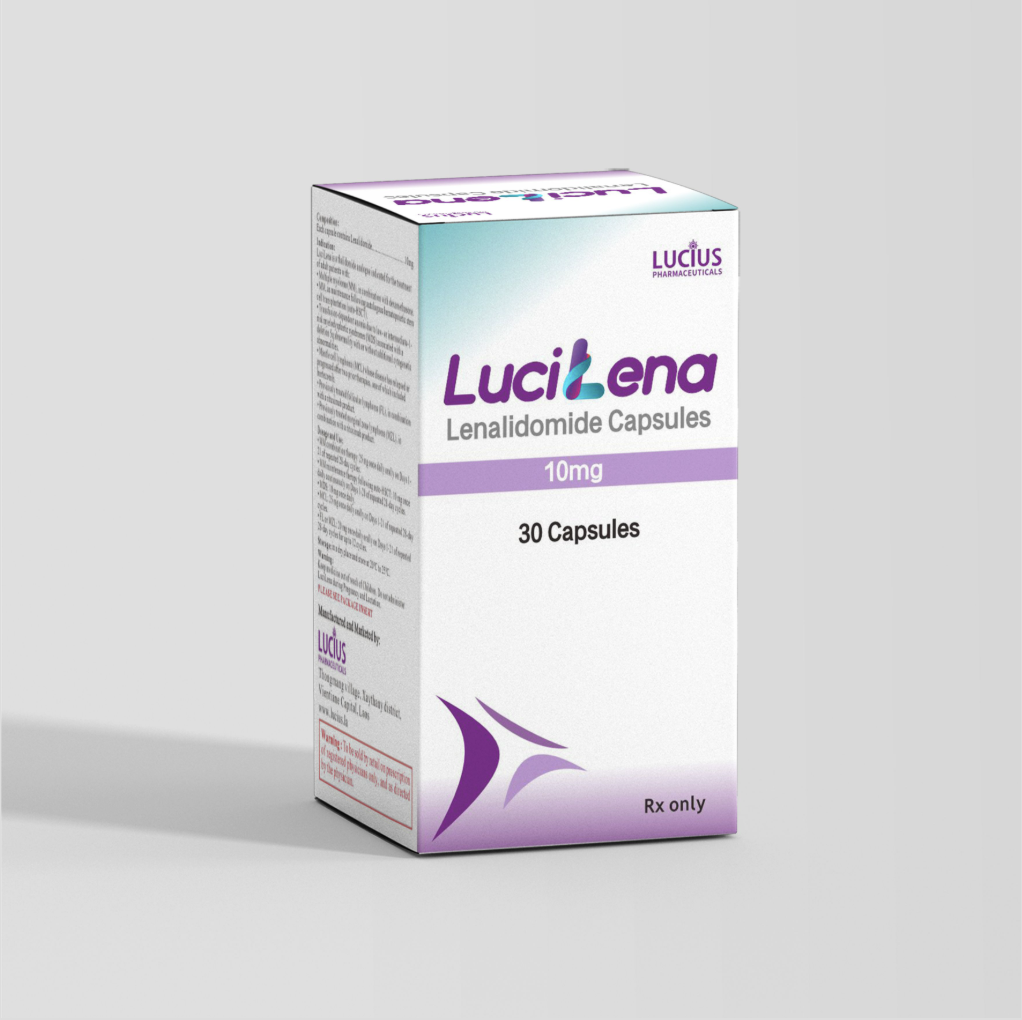
Capsules: 10 mg×30 capsules
CONTRAINDICATIONS
• Pregnancy.
• Demonstrated severe hypersensitivity to lenalidomide.
WARNINGS AND PRECAUTIONS
• Increased Mortality: serious and fatal cardiac adverse reactions occurred in patients with CLL treated with LuciLena (lenalidomide) .
• Second Primary Malignancies (SPM): Higher incidences of SPM were observed in controlled trials of patients with MM receiving LuciLena .
• Increased Mortality: Observed in patients with MM when pembrolizumab was added to dexamethasone and a thalidomide analogue .
• Hepatotoxicity: Hepatic failure including fatalities; monitor liver function. Stop LuciLena and evaluate if hepatotoxicity is suspected .
• Severe Cutaneous Reactions: Discontinue LuciLena for severe reactions .
• Tumor lysis syndrome (TLS) including fatalities: Monitor patients at risk of TLS (i.e., those with high tumor burden) and take appropriate precautions.
• Tumor fare reaction: Serious tumor fare reactions, including fatal reactions, have occurred during investigational use of LuciLena for chronic lymphocytic leukemia and lymphoma.
• Impaired Stem Cell mobilization: A decrease in the number of CD34+ cells collected after treatment (>4 cycles) with LuciLena has been reported. Consider early referral to transplant center .
• Early mortality in MCL: Higher rate of early deaths have occurred in patients with MCL .
• Hypersensitivity: Monitor patients for potential hypersensitivity. Discontinue LuciLena for angioedema and anaphylaxis.
ADVERSE REACTIONS
• MM: Most common adverse reactions (≥20%) include diarrhea, fatigue, anemia, constipation, neutropenia, leukopenia, peripheral edema, insomnia, muscle cramp/ spasms, abdominal pain, back pain, nausea, asthenia, pyrexia, upper respiratory tract infection, bronchitis, nasopharyngitis, gastroenteritis, cough, rash, dyspnea, dizziness, decreased appetite, thrombocytopenia, and tremor.
• MDS: Most common adverse reactions (>15%) include thrombocytopenia, neutropenia, diarrhea, pruritus, rash, fatigue, constipation, nausea, nasopharyngitis, arthralgia, pyrexia, back pain, peripheral edema, cough, dizziness, headache, muscle cramp, dyspnea, pharyngitis, and epistaxis.
• Non-Hodgkin’s Lymphoma (NHL: MCL, FL or MZL): Most common adverse reactions (≥15%) included neutropenia, thrombocytopenia, anemia, leukopenia, diarrhea, constipation, nausea, fatigue, pyrexia, cough, upper respiratory tract infection, and rash .
DRUG INTERACTIONS
• Digoxin: Monitor digoxin plasma levels periodically due to increased Cmax and AUC with
concomitant LuciLena therapy.
• Concomitant use of erythropoietin stimulating agents or estrogen containing therapies
with LuciLena may increase the risk of thrombosis.
USE IN SPECIFIC POPULATIONS
• Lactation: Advise not to breastfeed.
Storage
Store at 20℃ to 25℃ (68℉ to 77℉), excursions permitted between 15℃ and 30℃ (59℉ and 86℉) [see USP Controlled Room Temperature]. Protect from moisture.