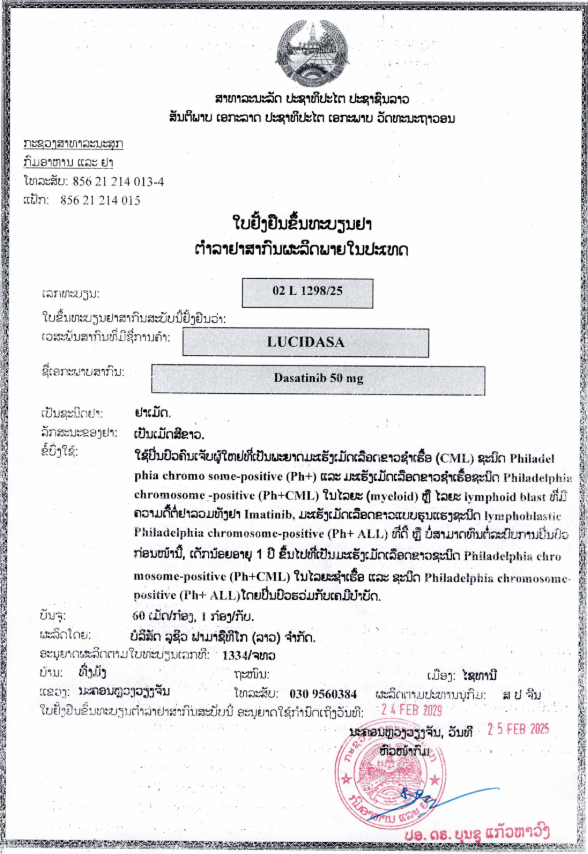
Character Instruction Manual: Lucius Dasatinib
Model Designation: Precision-Targeted Therapeutic Agent (Tyrosine Kinase Inhibitor Class)
Generic Name: Dasatinib
Brand Name: Lucius®
Strength: 20 mg
Core Function: To inhibit aberrant tyrosine kinase signaling, specifically targeting the BCR-ABL oncoprotein, for the management of certain leukemias.
1. Overview & Specifications
Lucius Dasatinib is a highly specialized, targeted molecular agent. It is not a blunt instrument like chemotherapy; it is a precision key designed to fit into and block specific malfunctioning locks (kinases) within cancer cells, halting their uncontrolled growth and proliferation.
-
Therapeutic Class: Tyrosine Kinase Inhibitor (TKI)
-
Targets: BCR-ABL, SRC family kinases, KIT, EPHA2, PDGFRβ
-
Primary Indication: Philadelphia chromosome-positive (Ph+) leukemias
-
Administration: Oral
-
Appearance: White to off-white, film-coated tablet
2. Core Operating Principles (Mechanism of Action)
WARNING: Understanding this mechanism is crucial for predicting efficacy and side effects.
-
Principle 1: Targeted Inhibition. In Ph+ leukemias, a genetic mishap creates the BCR-ABL "oncogene," a constantly active signal telling cells to divide. Dasatinib binds with high affinity to the ATP-binding site of this protein, switching the "divide now" signal off.
-
Principle 2: Broad-Spectrum Activity. Unlike its predecessor (imatinib), Dasatinib can bind to and inhibit multiple kinase targets. This makes it effective against many resistant forms of the BCR-ABL protein but also contributes to its unique toxicity profile.
-
Principle 3: Cellular Apoptosis. By blocking these critical survival signals, the agent induces programmed cell death (apoptosis) primarily in the malignant cells that rely on them, while largely sparing healthy cells.
3. Startup & Initialization (Dosing & Administration)
-
Loading Protocol: Initiation must be under the supervision of an oncology specialist.
-
Chronic Phase CML: Standard initial dose is 100 mg once daily.
-
Advanced Phase CML/Ph+ ALL: Standard initial dose is 140 mg once daily.
-
-
Administration Instructions:
-
Route: Oral.
-
Method: Swallow tablet whole with a glass of water. Do not crush, cut, or chew.
-
Timing: Can be taken with or without food. Administration at the same time each day is recommended to maintain stable plasma concentrations.
-
-
Role of the 20mg Unit: This strength is primarily used for dose modulation. It allows for fine-tuning the dosage (e.g., reducing from 100mg to 80mg or from 140mg to 120mg) in response to toxicity.
4. Monitoring & Feedback Systems (Lab & Clinical Monitoring)
This unit requires constant data streaming to ensure optimal performance and safety.
-
Essential Monitoring Parameters:
-
Complete Blood Count (CBC): Weekly for the first 2 months, then monthly. Critical for detecting myelosuppression (low platelets, neutrophils, red cells).
-
BCR-ABL Molecular Testing: (e.g., PCR) every 3 months to quantify response to therapy.
-
Liver Function Tests (LFTs): Periodically.
-
Electrolytes: Monitor for low levels of phosphate, calcium, and magnesium.
-
-
Physical System Checks:
-
Cardiopulmonary Monitoring: Monitor for signs of fluid retention (weight gain, swelling, shortness of breath, dry cough) which may indicate pleural effusion or pulmonary arterial hypertension (PAH).
-
Bleeding Assessment: Monitor for unusual bruising or bleeding.
-
5. Potential System Errors (Adverse Reactions)
CRITICAL ALERTS:
-
Myelosuppression: Grade 3/4 thrombocytopenia, neutropenia, and anemia are common. May require dose interruption/reduction or supportive care (transfusions, growth factors).
-
Fluid Retention: Can range from peripheral edema to severe pleural effusions. Requires prompt medical evaluation; may require diuretics, dose reduction, or discontinuation.
-
Bleeding Events: Can be severe, including CNS hemorrhage. Use with caution in patients on anticoagulants.
-
Pulmonary Arterial Hypertension (PAH): A rare but serious complication. Symptoms include dyspnea, fatigue, hypoxia. May be reversible upon discontinuation.
-
QT Prolongation: Can occur. Correct hypokalemia and hypomagnesemia before and during use.
OTHER FREQUENT NOTIFICATIONS:
-
Diarrhea, headache, nausea, rash, fatigue, musculoskeletal pain.
6. Compatibility & Interactions (Drug-Drug Interactions)
WARNING: This unit has significant interaction potential.
-
Strong CYP3A4 Inhibitors (e.g., ketoconazole, itraconazole, clarithromycin): AVOID. Concomitant use will significantly increase Dasatinib plasma levels and toxicity. If necessary, consider a Dasatinib dose reduction.
-
Strong CYP3A4 Inducers (e.g., rifampin, phenytoin, St. John's Wort): AVOID. Concomitant use will significantly decrease Dasatinib plasma levels, reducing efficacy. Consider alternative agents.
-
Antacids/H2 Blockers/PPIs: Reduce Dasatinib absorption. Administer antacids 2 hours before or after Dasatinib. Avoid H2 blockers and PPIs if possible; consider alternatives.
7. Contraindications & Safety Protocols
-
Contraindication: Hypersensitivity to dasatinib or any component of the formulation.
-
Pregnancy & Lactation: Pregnancy Category D. Can cause fetal harm. Female patients of reproductive potential must use effective contraception during and for several weeks after treatment. Do not breastfeed.
8. Storage & Handling
-
Storage Conditions: Store at 20°C to 25°C (68°F to 77°F). Excursions permitted between 15°C and 30°C (59°F and 86°F).
-
Handling: No special handling requirements. As with all medications, keep out of reach of children and pets.
Final Note:
Lucius Dasatinib 20mg is a critical component in the arsenal against Ph+ leukemias, particularly when resistance or intolerance to first-line therapy occurs. Its power lies in its precision, but this is matched by a need for meticulous monitoring and management of its unique toxicities. Adherence to dosing, monitoring schedules, and awareness of interactions are paramount to achieving a successful and sustained therapeutic outcome.
This is a character-inspired summary and is not a substitute for the full official prescribing information. All treatment must be managed by a qualified healthcare professional.
whatsapp:+852 61905607
wechat:yindu7689